© 2026 Rentokil North America © RK Environmental Services – All Rights Reserved.
The term pesticide is broadly used to describe a substance intended to control or destroy insects, weeds, and other organisms that may harm cultivated plants or animals. Within that broad category are products with different formulations, modes of action, application methods, and target organisms.
Many pesticides used in agriculture and horticulture are systemic. Unlike contact pesticides, which remain primarily on the treated surface, systemic pesticides are absorbed by a plant and transported through its tissues. This movement can make portions of the plant—or, in some cases, the entire plant—toxic to insects that feed on it. Systemic herbicides work in a similar way but target the plant itself, moving through its vascular system to control unwanted weeds and vegetation.
Understanding how systemic pesticides move through plants is important. Their mobility can make them effective pest-management tools, but it also requires careful consideration of application methods, environmental conditions, non-target organisms, and applicable licensing requirements.
How Systemic Insecticides Move Through Plants
Systemic insecticides are used to manage a wide variety of insects, mites, and nematodes. Many active ingredients are approved for use on numerous agricultural crops. These products are also commonly used on nursery and greenhouse plants, landscape plantings, trees, turf, and certain non-crop sites, including animal feeds and Christmas trees.
Some systemic insecticides are absorbed through a plant’s roots and transported into above-ground tissues through the xylem. The xylem is the part of the plant’s vascular system that carries water and dissolved materials upward from the roots.
Common application methods for xylem-mobile insecticides include:
- Seed treatments
- Chemigation
- Soil granules
- Soil drenches
- Soil injection
Trunk injection is another method of introducing insecticides directly into the xylem. It is commonly used on orchard crops and woody plants grown in nurseries or maintained in landscaped environments. Certain systemic products may also be applied to trees as basal bark sprays. This includes:
- Xylem-mobile insecticides: These can be applied to foliage, but foliar application may result in less movement throughout the plant. Leaves can present natural barriers to absorption, and rain, dew, or mist may remove some of the product before it is taken up.
- Phloem-mobile systemic insecticides: Typically applied as foliar sprays. Once absorbed, they move through the plant’s phloem vessels and may reach developing leaves, roots, nectar, or seeds.
Considerations for Pollinators
Systemic activity can provide extended control, but it may also create concerns for bees and other pollinators. Because systemic chemicals can remain in plant tissue for some time, precautions that reduce immediate contact may not always eliminate the possibility of exposure.
For example, spraying at night or applying a product outside the flowering season may help limit direct contact during application. However, if the active ingredient remains in plant tissue and later moves into nectar or pollen, harmful exposure may still occur.
For this reason, applicators should consider product selection, application method, plant species, flowering stage, environmental conditions, label requirements, and potential effects on non-target organisms in the decision making process.
Systemic Herbicides and Right-of-Way Applications
Systemic herbicides are absorbed through a plant’s leaves or roots and then translocated to other areas of the plant. A foliar-applied herbicide may move downward through the plant, while a soil-applied product may be absorbed by the roots and move upward toward the leaves. By reaching the plant’s vascular system, a systemic herbicide can control more than the vegetation visible at the time of treatment.
These products are frequently used in right-of-way vegetation management programs. Right-of-way applications may be necessary to remove vegetation that:
- Obstructs roads or travel routes
- Creates weed vectors
- Limits visibility or access
- Interferes with utility operations
- Encroaches on power or communication lines
- Affects transmission and distribution infrastructure
While these applications can serve an important operational and safety function, they require care. Aerial and broadcast treatments may affect vegetation beyond the intended treatment area if they are not properly planned and executed. Damage to non-target vegetation can also affect wildlife habitats, aquatic organisms, and pollinators.
Detailed site assessments should be completed before treatment. Applicators should evaluate nearby desirable vegetation, water sources, weather conditions, drift potential, sensitive habitats, and public-use areas. They must also follow all product-label directions and applicable regulatory requirements.
In many states and municipalities, right-of-way pesticide applications require specialized training, certification, or licensing. Requirements should always be verified before an application is performed.
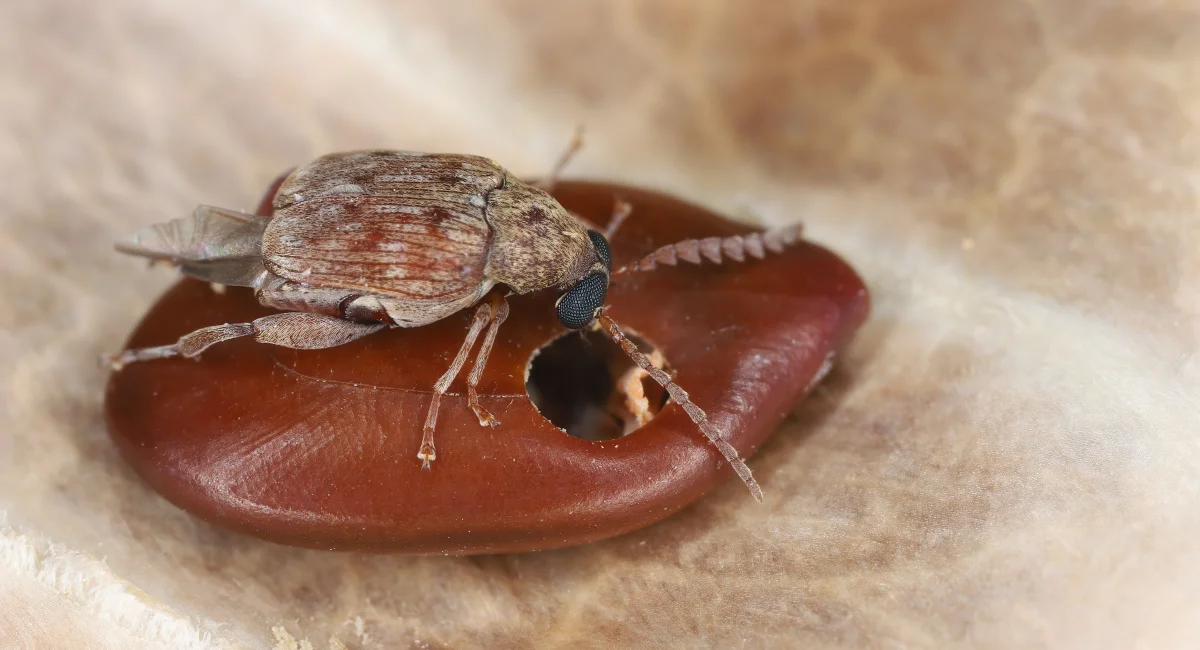
The Bean Weevil
Order: Coleoptera
Family: Chrysomelidae
Subfamily: Bruchinae
Bean weevils, also known as seed beetles, are a subfamily of beetles in the family Chrysomelidae. They are granivores and typically infest various kinds of seeds and beans, living most of their lives inside a single seed. The subfamily includes approximately 1,650 species found throughout the world.
Like most food infesting beetles, bean weevils are small, measuring approximately 3.5 to 5 millimeters in length. They are generally dark brown or black and have compact, oval-shaped bodies, often with mottled or striped patterns.
Although they are commonly called weevils, bean weevils are actually beetles and lack the distinctive snouts associated with true weevils.
Life Cycle and Damage
The female bean weevil deposits her eggs on bean pods in the field or on whole beans in storage. The larval stage is the most destructive period of the insect’s life cycle because adult bean weevils do not feed.
After hatching, the larvae enter the beans and develop internally. Upon reaching maturity, they pupate near the surface of the bean. Adults then emerge, leaving visible holes in the product.
Depending on environmental conditions, the entire life cycle may last from 21 to 80 days.
Prevention and Control
Control practices for bean weevils are similar to those used for other stored product and food infesting pests.
Recommended practices include:
- Conducting thorough inspections to identify potential infestations
- Maintaining effective stock rotation procedures
- Discarding infested materials
- Freezing affected products when appropriate
- Using fumigation in extreme cases to stop pest development
Traditional chemical control methods are generally less effective against bean weevils because much of the insect’s life cycle occurs inside the bean.
Book Your Free Pest Inspection Today
Our local technicians will assess your property and recommend tailored solutions. Fast, friendly, and completely obligation-free.
- Safe, targeted treatments
- Local experts, fast response
- Trusted, trained technicians